
Climate Adaptation: Embodied Carbon
Making a case to leverage existing and historic buildings for zero net carbon
4. Embodied Carbon
Embodied carbon is the associated carbon dioxide emissions as a result of production, transportation, and installation of building materials and components on-site. They account for a large percentage of a building’s total life cycle emissions, especially in high embodied carbon materials such as concrete, cement mortar, steel, aluminum, PVC products, and petroleum-based products. Europe recognizes the importance of reducing embodied carbon in cross-sector supply chains, the reuse of existing infrastructure and buildings are part of this wave of sustainable construction practices.11
If a building is demolished, there is a waste of embodied energy from its entire lifecycle.
For example, carbon emissions released before the building or infrastructure begins to be used, or upfront carbon, will be responsible for half of the entire carbon footprint of new construction between now and 2050. This threatens to consume a large part of our remaining carbon budget. A net zero embodied carbon building (new or renovated), is highly resource-efficient with upfront carbon minimized to the greatest extent possible, and all remaining embodied carbon reduced or offset in order to achieve net zero across the lifecycle.12
Principles to follow in reducing embodied carbon:12
1. Prevent
2. Reduce and optimize
3. Plan for the future
4. Offset
Load-bearing elements such as concrete, steel and asphalt, are carbon-intensive materials, and often contribute the majority of emissions. Focusing on building elements as a principal source of embodied carbon presents an opportunity to ensure that structures achieve the maximum possible useful life, which therefore supports a case for retrofitting against demolition.
For instance, cement manufacture is responsible for around 7% of global carbon emissions, with steel also contributing 7-9% to the global total, around half of which can be attributed to buildings and construction. Each building renewal project is unique, but almost all of them retain the biggest source of embodied carbon: the structure.12
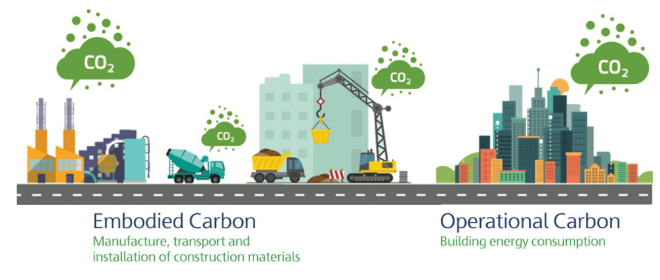
Embodied Carbon vs. Operational Carbon. Understanding Carbon; Stacy Smedley, SKANSKA/CLF.
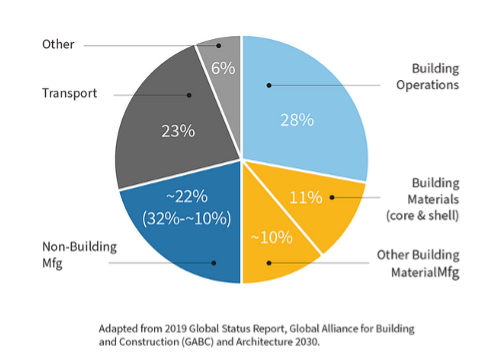
Breakdown of global carbon emissions by sector. Global Alliance for Building and Construction and Architecture 2030.
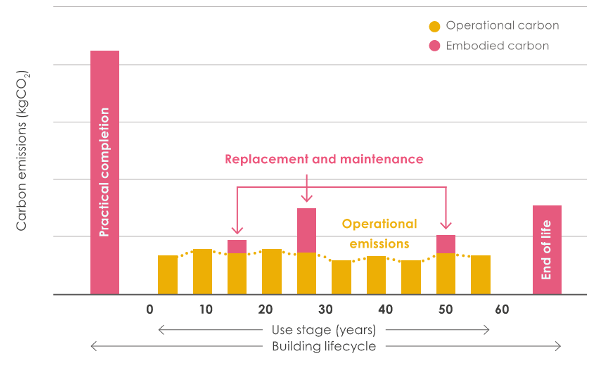
Emissions breakdown throughout a building’s lifecycle. London Energy Transformation Initiative. LETI Embodied Carbon Primer: Supplementary Guidance to the Climate Emergency Design Guide. World Green Building Council, 2020. (p. 9)
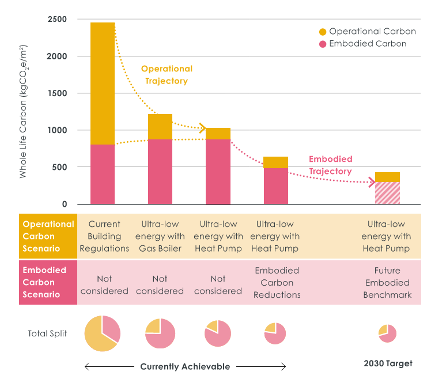
Operational and embodied carbon trajectories. London Energy Transformation Initiative. LETI Embodied Carbon Primer: Supplementary Guidance to the Climate Emergency Design Guide. World Green Building Council, 2020. (p.18)
[11] Carrig Conservation International. Energy Efficiency in Traditional Buildings: Draft guidance for public consultation. Government of Ireland, Department of Housing, Local Government and Heritage, 2021.
[12] Advancing Net Zero, WGBC, RAMBOLL and C40 Cities. Bringing Embodied Carbon Upfront: Coordinated action for the building and construction sector to tackle embodied carbon. P. 11-24.
Navigate to the next pages
 |
 |
 |
 |
 |
 |
 |
 |