
Understanding heritage as the human imprint on the earth, Heritage BC recognizes that heritage professionals, volunteers, and enthusiasts must fully commit to learning about and respecting the diversity and inclusivity of experiences and perspectives that form our local and provincial heritage.
- Heritage 101
- Advocacy
- Accessibility for Historic Places
- Climate & Sustainability
- Cultural Maps
- Heritage Place Conservation
- Heritage Policy & Legislation
- Homeowners
- Intangible Cultural Heritage
- Reconciliation
- Indigenous Cultural Heritage
- Setting the Bar: A Reconciliation Guide for Heritage
- 1. Heritage and Reconciliation Pledge
- 2. Acknowledging Land and People
- 3. Celebrating Days of Recognition and Commemoration
- 4. With a Commitment to Learn
- 5. Committing to Strategic Organizational Diversity
- 6. Mission-Making Room for Reconciliation
- 7. Possession, Interpretation, Repatriation and Cultural Care
- 8. Shared Decision Making
- 9. Statements of Significance and other heritage planning documents
- 10. Heritage Conservation Tools, Local Government Act
- Racism: Do Not Let the Forgetting Prevail
- Taking Action: resources for diversity and inclusion
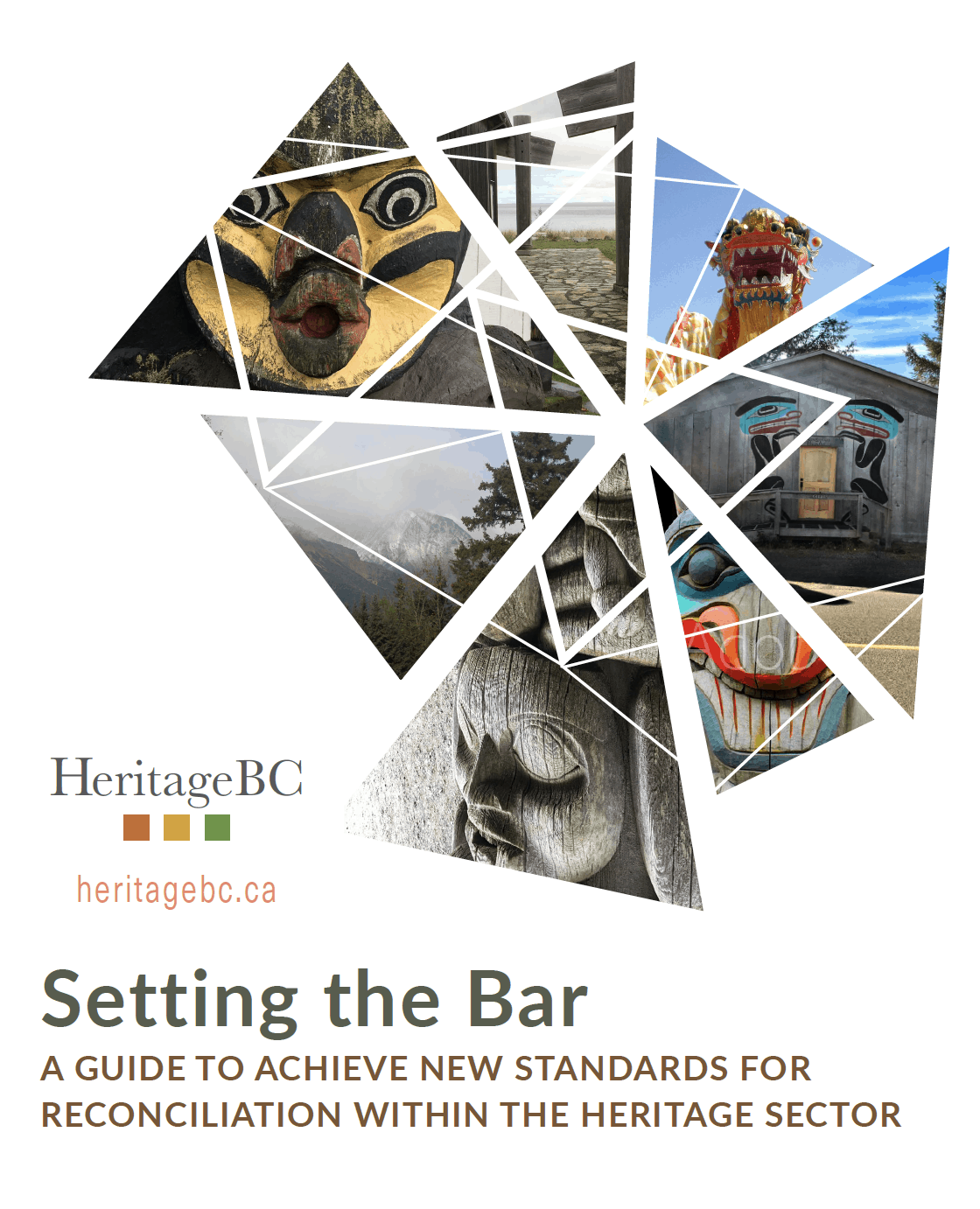
Setting the Bar: A Guide to Achieve New Standards for Reconciliation within the Heritage Sector
Heritage BC recognizes that the heritage field has its roots in the Western, colonial systems of knowledge and practice, which have been imposed upon other cultures and peoples. Today, there is a movement to acknowledge with humility the harm that this has caused and to acknowledge the need for redress.
Heritage BC also recognizes reconciliation will not be achieved through a single process, but it requires an ongoing commitment to make things better, and to be accountable, through a range of actions that are carefully developed according to the needs and circumstances of each situation.
“Setting the Bar” offers a set of ten standards and calls to action to drive heritage organizations forward, beyond conversation, to take concrete, measurable action. This will prompt each one of us to act and to reframe the embedded systems and challenge the all-too-familiar contexts of our work. Each action can be easily achieved with a willingness to be open to ideas and perspectives, as well as a willingness for self-reflection and the resolve for quantifiable improvement.
A note about “Setting the Bar”
Created in 2021 with the support of an extraordinary group of advisors, this document is part of Heritage BC’s commitment to support BC’s heritage sector’s efforts toward redress and reconciliation and expanded recognition of cultural heritage of Indigenous and culturally diverse peoples.
Heritage BC is indebted to those who took the time to share their expertise and advice.
- Janice Alpine, Ktunaxa Nation Council, Tourism Engagement/Business Development Officer
- Angie Bain, Researcher, Union of British Columbia Indian Chiefs; Director, Heritage BC
- Marsha ‘Ḵwa’x̱i’latł’ Dufresne, Director, Tumbler Ridge Global Geopark
- Sharanjit Kaur Sandhra, PhD, History, UBC; Co-Curator, Sikh Heritage Museum, National Historic Site Gur Sikh Temple
- Vincent Kwan, City of Vancouver (formerly with the Dr. Sun Yat Sen Classical Chinese Gardens); Director, Heritage BC
- Silvia Mangue, Founder and Manager, Kulea Culture; President, BC Black History Awareness Society
- Kamala Todd, Adjunct Professor, Urban Studies SFU and UBC SCARP; Community Planner; Filmmaker
Heritage BC also thanks BC Museums Association for its support and advice.
The following are those actions that are well within the capabilities of all heritage organizations and that, collectively, will result in an impactful difference.
“Diversity is what makes us different, but inclusion is what makes us strong.”
Advisor to the project
